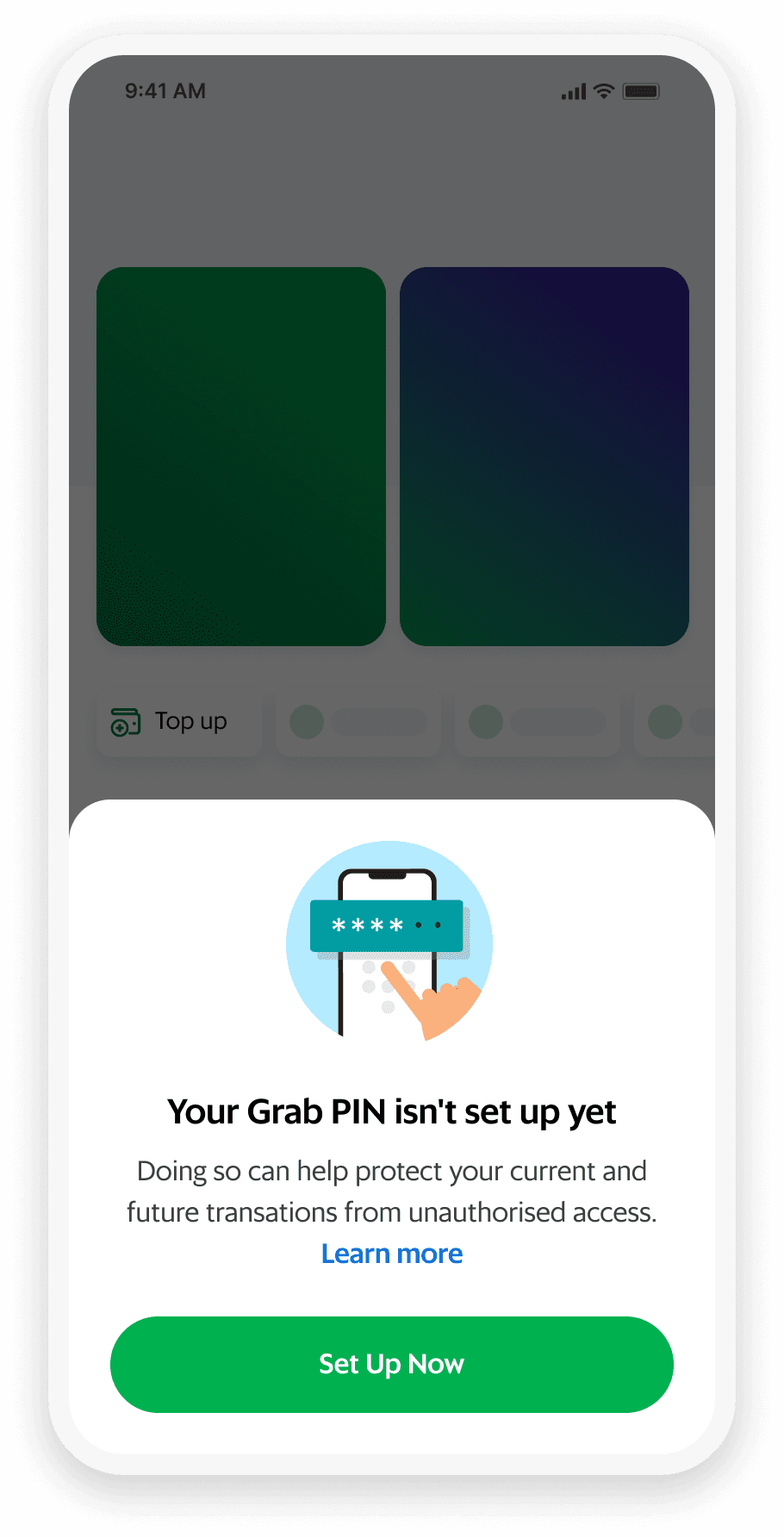
PIN Adoption 2.0
PIN Adoption 2.0
PIN Adoption 2.0

Experimentation to Drive PIN Setup Among New & Existing Cashless Users

Experimentation to Drive PIN Setup Among New & Existing Cashless Users

Experimentation to Drive PIN Setup Among New & Existing Cashless Users

🏢
GrabFin
GrabFin
GrabFin
🗓️
2021
2021
2021
🚀
Launched
Launched
Launched
🎯
+8% PIN Adoption Rate

Disclaimer: To uphold confidentiality, some details and designs have been intentionally omitted or modified.

Disclaimer: To uphold confidentiality, some details and designs have been intentionally omitted or modified.

Why PIN?
Why PIN?
Why PIN?

User accounts taken over by fraudsters reached an all-time high

The absence of multi-factor authentication (MFA) damaged user trust and attracted scrutiny from local regulators regarding Grab's account security measures. To address this, the GrabFin Trust team implemented a mandatory PIN setup on all cashless transaction flows.

The absence of multi-factor authentication (MFA) damaged user trust and attracted scrutiny from local regulators regarding Grab's account security measures. To address this, the GrabFin Trust team implemented a mandatory PIN setup on all cashless transaction flows.

PIN Adoption 1.0
PIN Adoption 1.0
PIN Adoption 1.0

Diagnosing the real problem

When the GrabFin Trust team mandated PIN setup in Phase 1.0 to address account security concerns, we saw immediate results of 4x increase in adoption. However, as I analyzed the data more closely, I noticed something concerning.


We had successfully converted the easy users, but 13% of existing users and 5% of new users in our key markets were abandoning cashless transactions entirely rather than set up a PIN.


This wasn't just about adoption metrics—we were inadvertently creating a security problem by pushing users toward less secure payment methods or driving them away from our platform completely.

When the GrabFin Trust team mandated PIN setup in Phase 1.0 to address account security concerns, we saw immediate results of 4x increase in adoption. However, as I analyzed the data more closely, I noticed something concerning.


We had successfully converted the easy users, but 13% of existing users and 5% of new users in our key markets were abandoning cashless transactions entirely rather than set up a PIN.


This wasn't just about adoption metrics—we were inadvertently creating a security problem by pushing users toward less secure payment methods or driving them away from our platform completely.

The Problem
The Problem
The Problem

Mandatory PIN setup in phase 1.0 discouraged both new and existing users from engaging in cashless spending and topping up their Grab wallets.

Mandatory PIN setup in phase 1.0 discouraged both new and existing users from engaging in cashless spending and topping up their Grab wallets.

Mandatory PIN setup in phase 1.0 discouraged both new and existing users from engaging in cashless spending and topping up their Grab wallets.

My Role
My Role
My Role

As an individual contributor on the GrabFin Trust team, I realized the issue wasn't that users didn't want security. It was that we were forcing them to solve our problem (i.e account security), while interrupting them from solving their own problem (i.e completing a transaction).


The Phase 1.0 approach was a mandate, not a strategy. I saw an opportunity to reframe this entirely. Instead of forcing compliance, what if we could make PIN setup feels like a natural thing to do, even desirable part of high-value flows?

As an individual contributor on the GrabFin Trust team, I realized the issue wasn't that users didn't want security. It was that we were forcing them to solve our problem (i.e account security), while interrupting them from solving their own problem (i.e completing a transaction).


The Phase 1.0 approach was a mandate, not a strategy. I saw an opportunity to reframe this entirely. Instead of forcing compliance, what if we could make PIN setup feels like a natural thing to do, even desirable part of high-value flows?

Learnings From 1.0
Learnings From 1.0
Learnings From 1.0

Where and why were users dropping off?

Where and why were users dropping off?

Where and why were users dropping off?

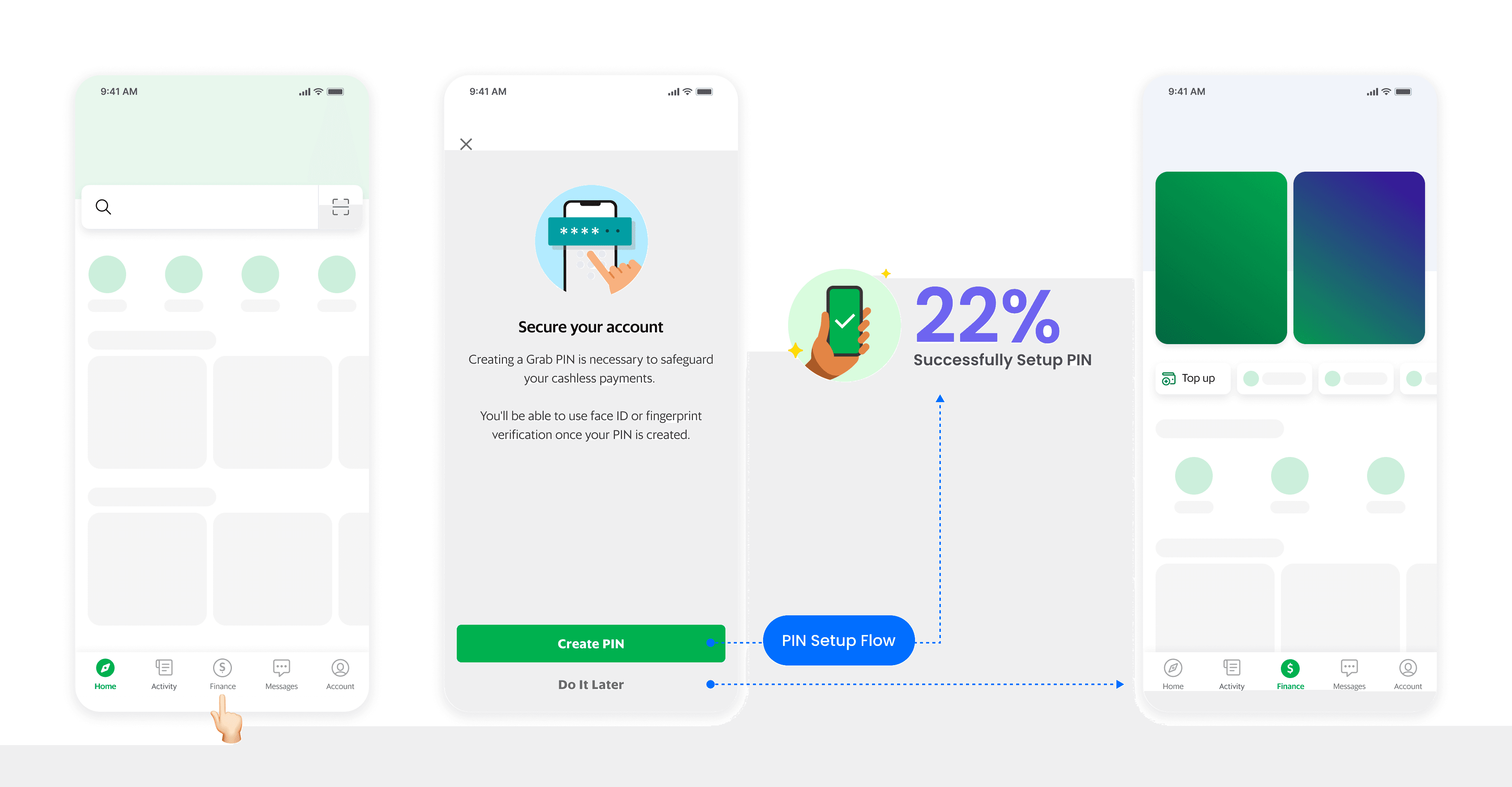
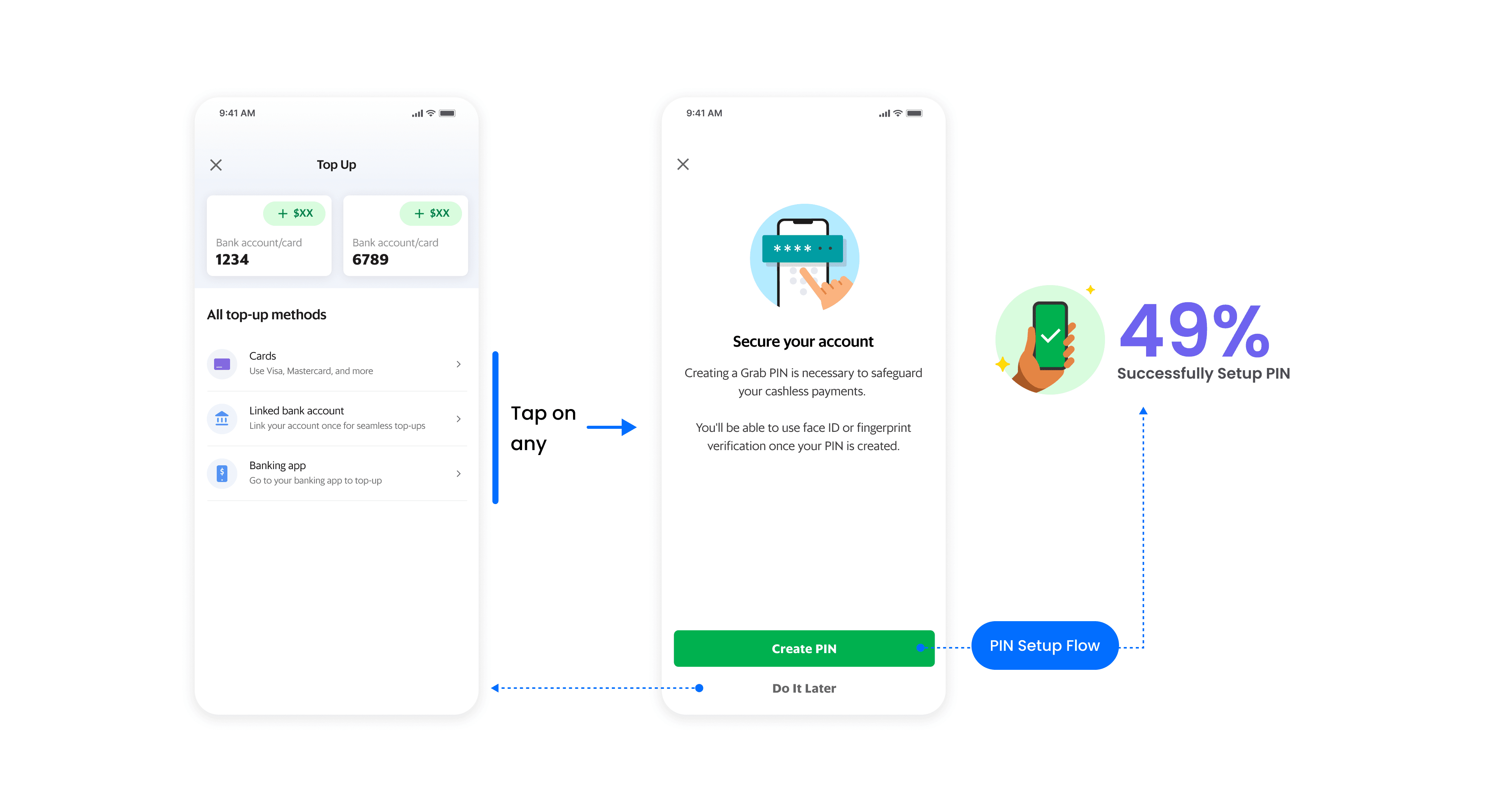
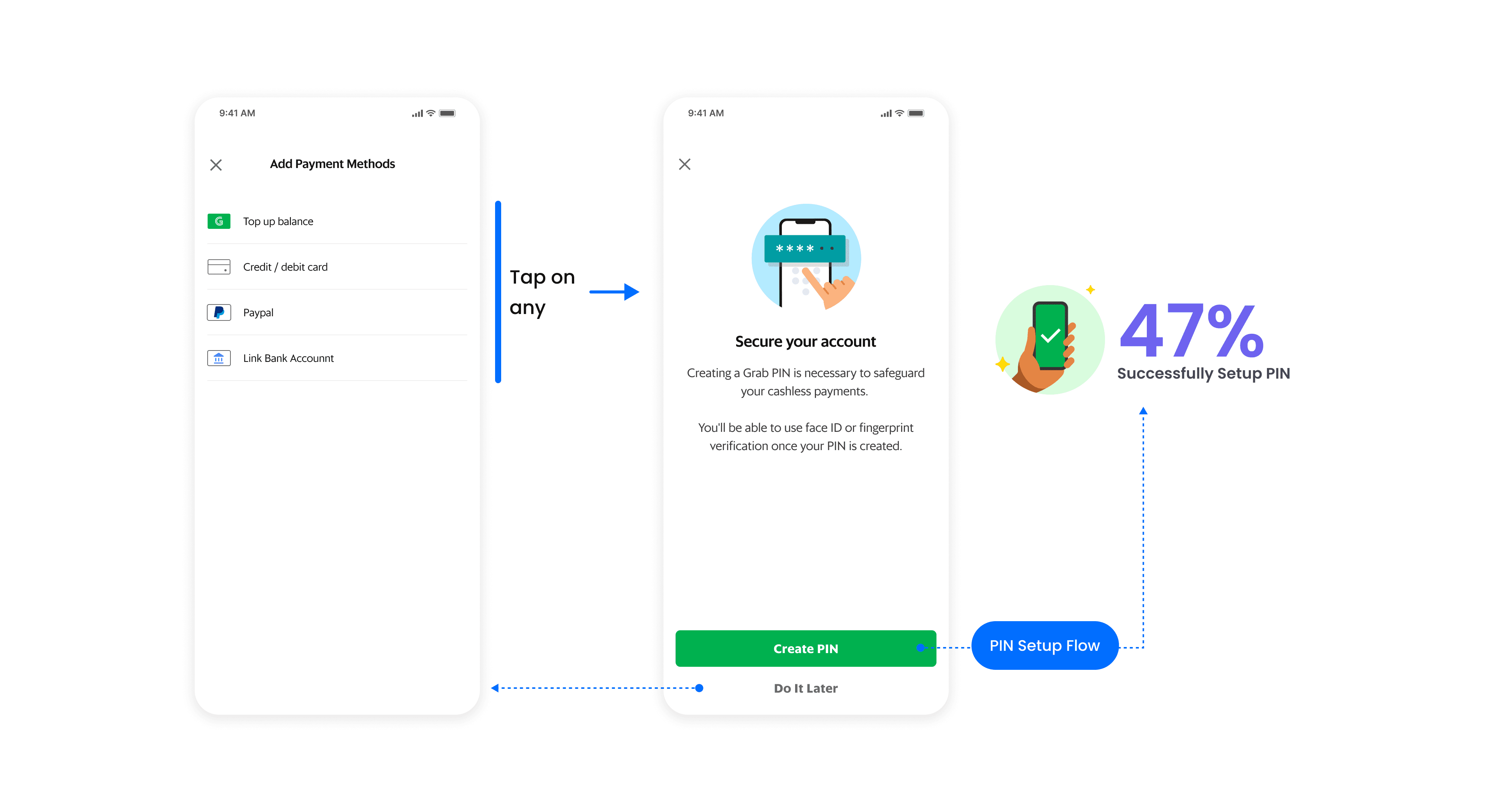
To understand the barriers to PIN setup, my team and I revisited phase 1.0 PIN prompts user flows, designed by a previous team.

To understand the barriers to PIN setup, my team and I revisited phase 1.0 PIN prompts user flows, designed by a previous team.

LEARNINGS FROM 1.0

We identified that:

We identified that:

  • Directing users to the PIN setup onboarding screen disrupted their intended tasks.

  • Many users immediately selected "Do It Later" leading to low conversion rates on the 'Finance' home screen.

  • The "Do It Later" option returned users to previous screens, where they either set up their PINs or dropped off entirely.

  • Users could still use existing payment methods without adding a new card or topping up their wallets.

  • Directing users to the PIN setup onboarding screen disrupted their intended tasks.

  • Many users immediately selected "Do It Later" leading to low conversion rates on the 'Finance' home screen.

  • The "Do It Later" option returned users to previous screens, where they either set up their PINs or dropped off entirely.

  • Users could still use existing payment methods without adding a new card or topping up their wallets.

Designing The Strategy

Rather than immediately implementing a new solution based on my intuition, I advocated for a systematic experimentation approach. I worked with my PM and Product Analyst to design a testing framework that would help us understand not just whether different trigger points worked, but why they worked and for whom.

I identified three fundamental questions we needed to answer:

  1. Does timing matter more than messaging — Do users respond better when we let them complete their intended task first?

  2. Does perceived risk drive urgency — Will users set up PINs more readily for high-value transactions when we make the security implications explicit?

  3. What's the right balance between conversion optimization and user experience — Should we make it harder or easier to defer PIN setup?
The Experimentation
The Experimentation
The Experimentation

Validating hypotheses for informed decision-making

Validating hypotheses for informed decision-making

Validating hypotheses for informed decision-making

For our experiment, each hypothesis tested a different psychological principle. I could have tested 'bottomsheet vs fullscreen' or 'one button vs two buttons,' but that would only tell us what worked, not why.


By designing experiments that tested specific behavioral hypotheses, we'd generate learnings we could apply to future security interventions beyond just PIN adoption.

Hypothesis #1
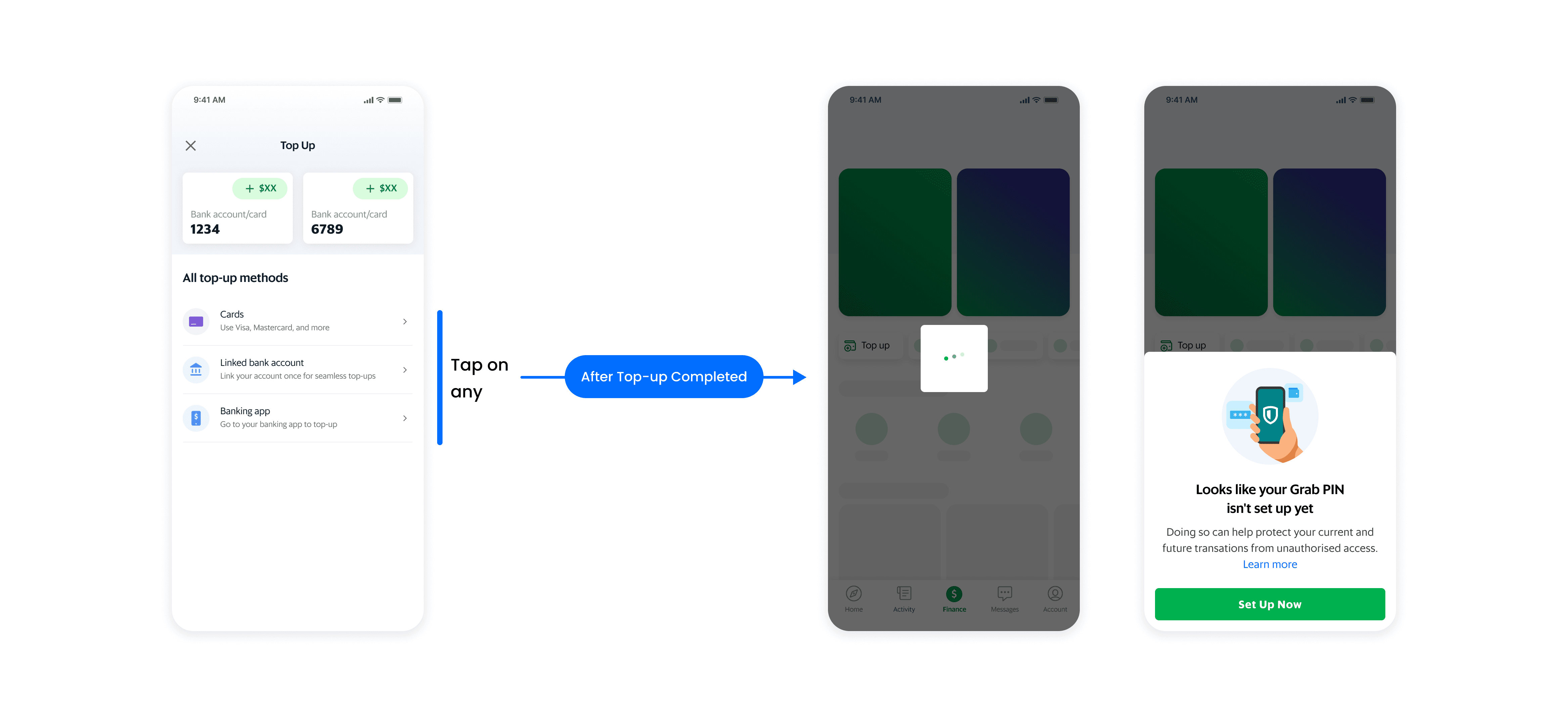
Users are more likely to set up their PINs when they can complete their intended tasks first.

To test this, we triggered PIN prompts at the end of a 'Top-up' flow and the bottomsheet was a deliberate choice. This is because full-screen prompts had failed in Phase 1.0 as it felt confrontational, as if the app was blocking users from their intended goal.


Additionally, bottomsheet creates visual hierarchy that says, "You've completed your task, and here's something else to consider." It also an established design language pattern for optional actions in mobile interfaces, setting the right expectation that this is important but not mandatory.

For our experiment, each hypothesis tested a different psychological principle. I could have tested 'bottomsheet vs fullscreen' or 'one button vs two buttons,' but that would only tell us what worked, not why.


By designing experiments that tested specific behavioral hypotheses, we'd generate learnings we could apply to future security interventions beyond just PIN adoption.

Hypothesis #1
Users are more likely to set up their PINs when they can complete their intended tasks first.

To test this, we triggered PIN prompts at the end of a 'Top-up' flow and the bottomsheet was a deliberate choice. This is because full-screen prompts had failed in Phase 1.0 as it felt confrontational, as if the app was blocking users from their intended goal.


Additionally, bottomsheet creates visual hierarchy that says, "You've completed your task, and here's something else to consider." It also an established design language pattern for optional actions in mobile interfaces, setting the right expectation that this is important but not mandatory.

THE EXPERIMENT

Hypothesis #2
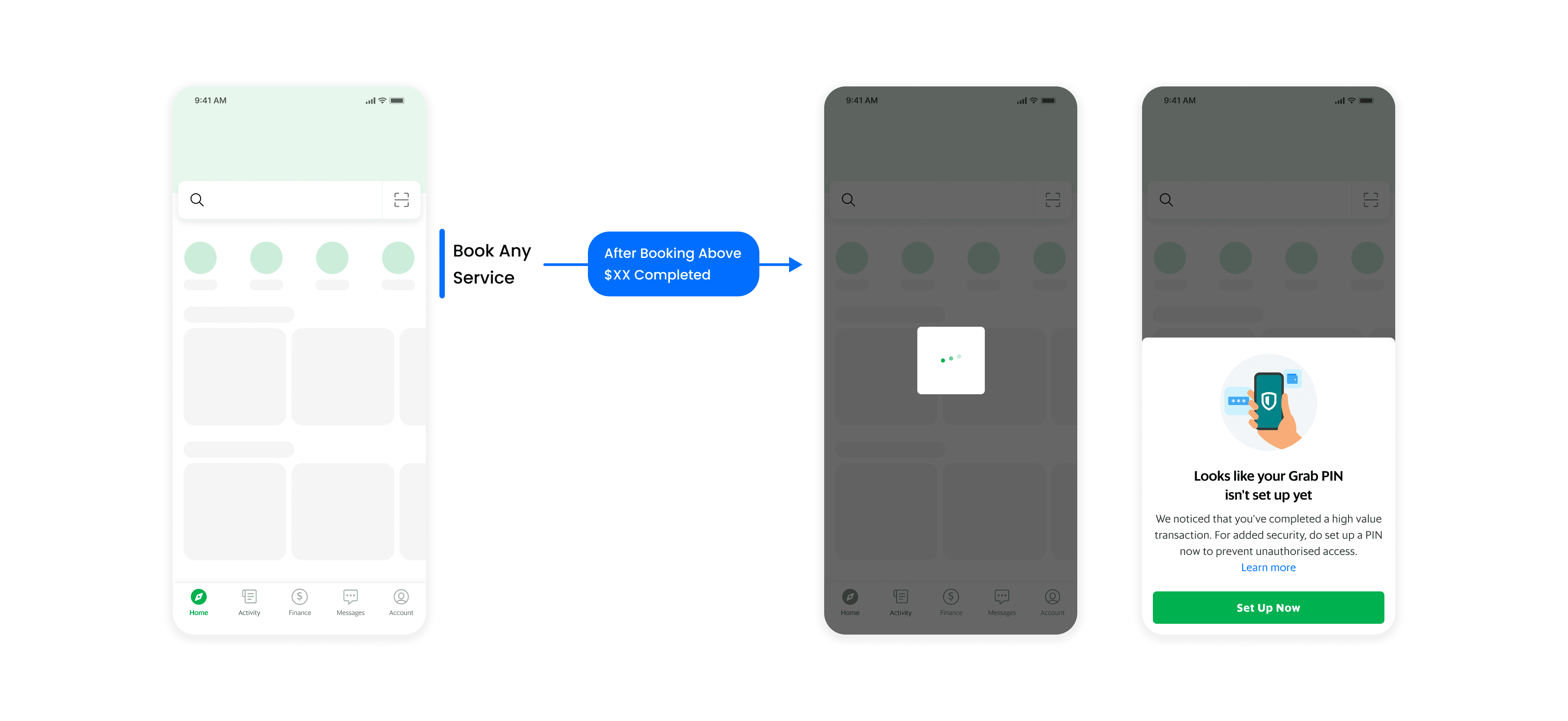
Users are more likely to set up their PINs for high-value transactions when reminded there is a risk of not protecting their accounts.

In this scenario, we prompted PIN setup only when transactions exceeded a specific threshold (i.e above $XX). Also, we ensured that the messaging was crafted to be more contextual and relevant.

Hypothesis #2
Users are more likely to set up their PINs for high-value transactions when reminded there is a risk of not protecting their accounts.

In this scenario, we prompted PIN setup only when transactions exceeded a specific threshold (i.e above $XX). Also, we ensured that the messaging was crafted to be more contextual and relevant.

THE EXPERIMENT

Hypothesis #3
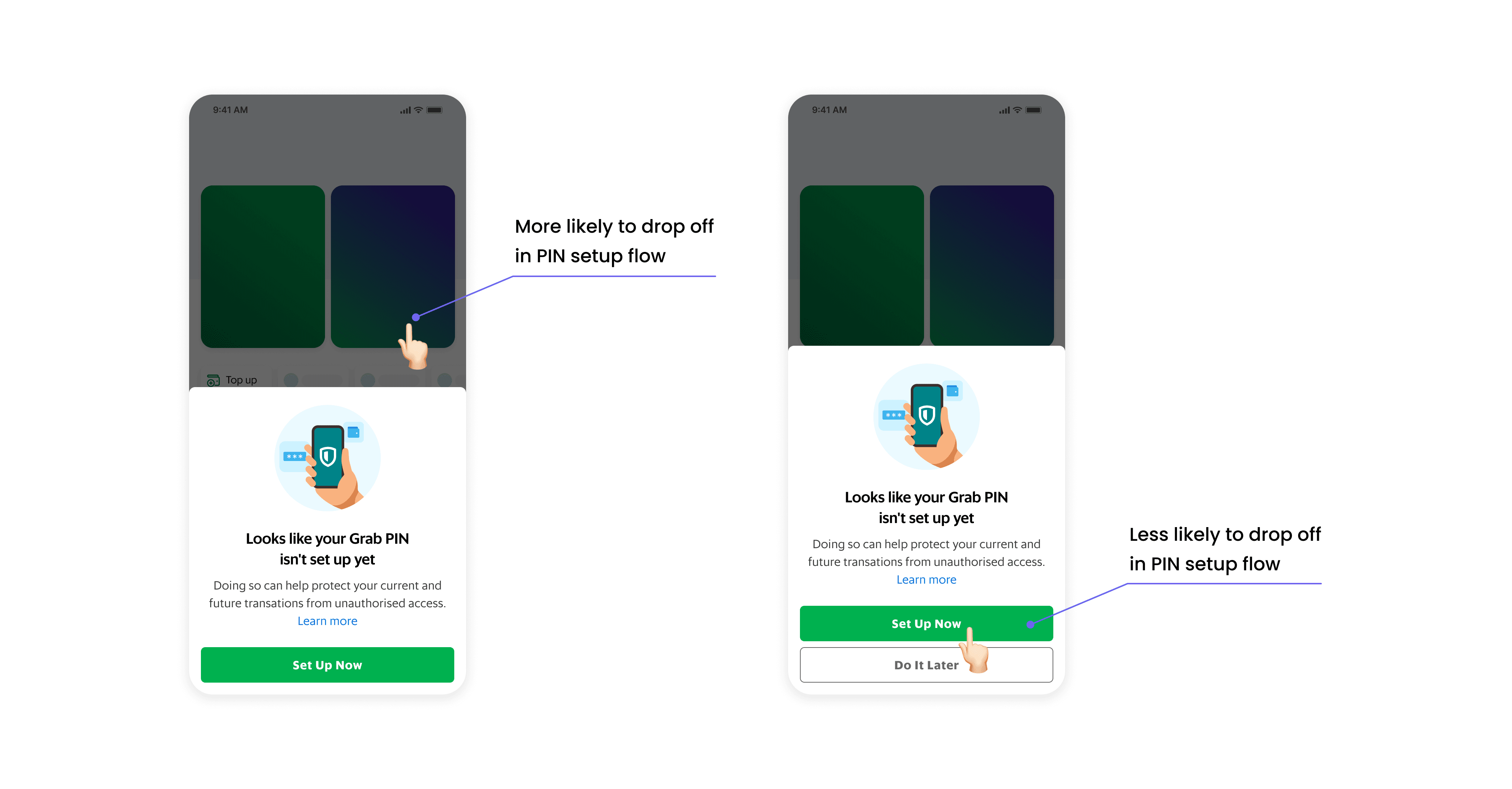
Most (non-android) users can dismiss the bottom sheet via the dark overlay, however, a "Do It Later" button may drive higher conversion as it indicates clear intention.

Lastly, we compared two variants of prompts: one with a single CTA and another that included the "Do It Later" option.

Hypothesis #3
Most (non-android) users can dismiss the bottom sheet via the dark overlay, however, a "Do It Later" button may drive higher conversion as it indicates clear intention.

Lastly, we compared two variants of prompts: one with a single CTA and another that included the "Do It Later" option.

The Results
The Results
The Results

What we learned from our experiment

What we learned from our experiment

What we learned from our experiment

  • Observed a higher PIN adoption when prompted at the end of a flow.

  • High-value transactions did not always equate to high-risk from user's perspective.

  • A single CTA resulted in more click-thru but also higher drop-offs as foreseen. Interestingly, compared to a double CTA, it still achieved a higher conversion rate.

  • Observed a higher PIN adoption when prompted at the end of a flow.

  • High-value transactions did not always equate to high-risk from user's perspective.

  • A single CTA resulted in more click-thru but also higher drop-offs as foreseen. Interestingly, compared to a double CTA, it still achieved a higher conversion rate.

Establishing Consistent Patterns

Standardizing bottomsheet component

Standardizing bottomsheet component

Standardizing bottomsheet component

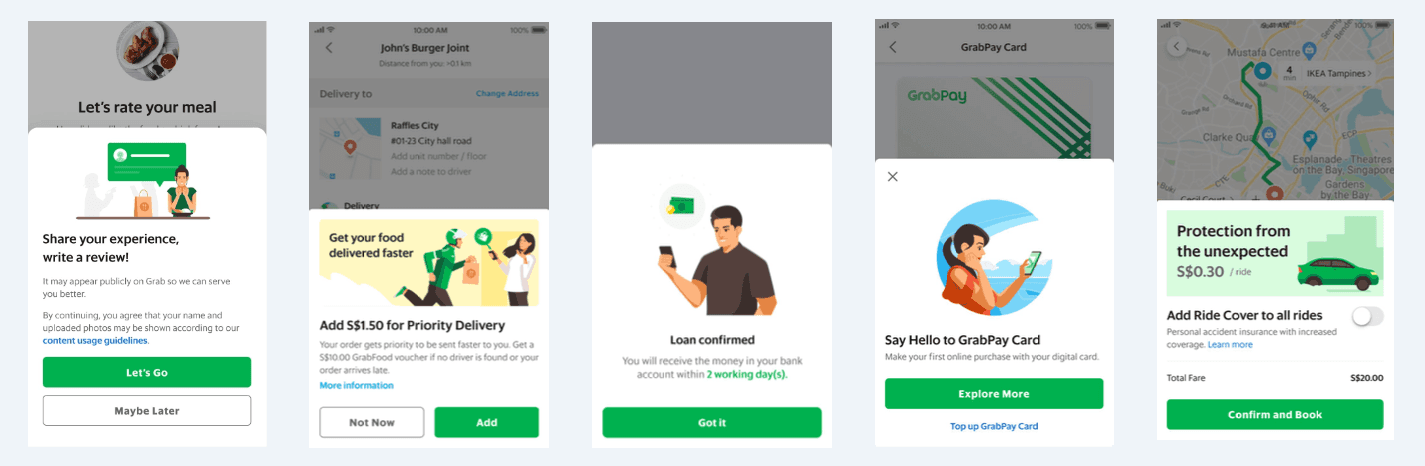
While working on the PIN adoption experiments, I noticed that our design library had multiple inconsistent bottomsheet implementations. This wasn't just an aesthetic inconsistency, it was creating cognitive load for users who were seeing different interaction patterns across the app, and it was forcing every designer to make the same decisions repeatedly.
DESIGN SYSTEM CONTRIBUTION

I saw this as an opportunity beyond my immediate project. Along with two other designers facing similar challenges, I initiated a collaboration to audit all bottomsheet usage across the platform, identify the common use cases, and propose a standardized component that would work for various contexts.

We documented not just the visual specifications but the interaction principles. Some examples are, when to use dismissible vs. persistent bottomsheets, how to handle keyboard interactions, accessibility requirements, and content guidelines etc.
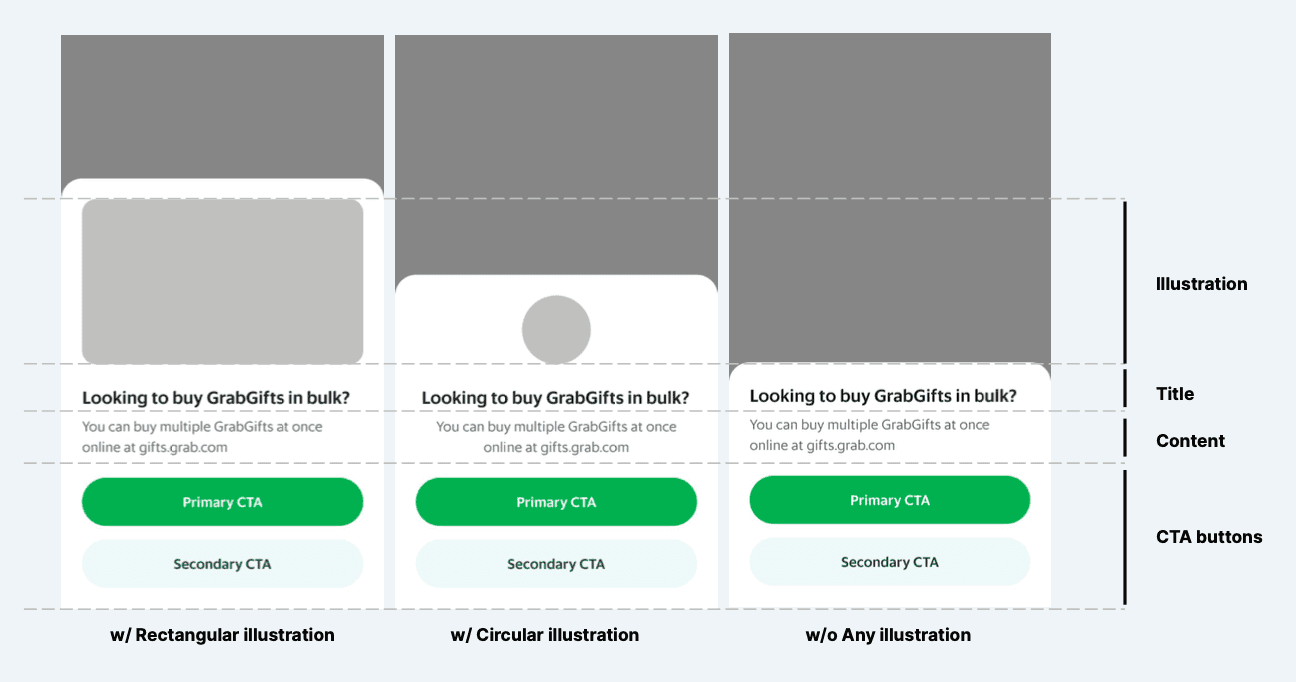
(Co-collaborators: Wen Xin, Ying Da)

(Co-collaborators: Wen Xin, Ying Da)

DESIGN SYSTEM CONTRIBUTION

Identifying opportunities for standardization had impact beyond just visual consistency. It accelerated design and development velocity by providing teams a proven pattern to implement. It improved user experience by creating predictable interactions across the platform, and established a model for how designers could contribute to the design system while collaborating and working on their own projects.

Impacts & Outcomes
Impacts & Outcomes
Impacts & Outcomes

+8%

+8%

+8%

Increase in PIN Adoption Rate meant that existing and new users who did not set up their PINs decreased from 18% to 10%.

+7%

+7%

+7%

Increase in Total Payment Volume (TPV) indicated that users tend to spend more when mandatory PIN setup was discarded.

+5%

+5%

+5%

Improvement in Top-Up Completion Rate as the removal of the PIN setup no longer obstructed users from topping up their wallets.
Learnings & Takeaways

What this taught us about security UX

This experiment validated a broader principle that has implications far beyond PIN adoption. Mandatory security measures often fail not because users don't care about security, but because we design them to conflict with users' primary goals.

The success of our end-of-flow prompts showed that users are most receptive to security interventions when they've already experienced value rather (i.e topped up their wallet or completed a transaction) than getting interrupted.

This insight has informed how we think about security UX across the entire platform. Rather than viewing security as something we enforce on users, we've started designing security interventions as value-added services that happen in natural moments of pause.

Moving away from “How do we make users do what we need?” and toward “When are users most receptive to our recommendations?” signals a more mature, user-centered approach to designing behavioral change at scale.

Does a single CTA work better?

Does a single CTA work better?

Does a single CTA work better?

It depends.


If our goal is to boost conversion rates, a primary CTA can effectively drive traffic and compel users to complete the side task even if they initially lacked that intent. Conversely, if we aim to enhance user experience by allowing them to exit situations easily, a secondary CTA may be more appropriate.

It depends.


If our goal is to boost conversion rates, a primary CTA can effectively drive traffic and compel users to complete the side task even if they initially lacked that intent. Conversely, if we aim to enhance user experience by allowing them to exit situations easily, a secondary CTA may be more appropriate.

Do reach out to learn more about this case study

Do reach out to learn more about this case study

Do reach out to learn more about this case study

Designed in Figma. Built in Framer.

Designed in Figma. Built in Framer.

© 2025 Kendrick Leow

© 2025 Kendrick Leow